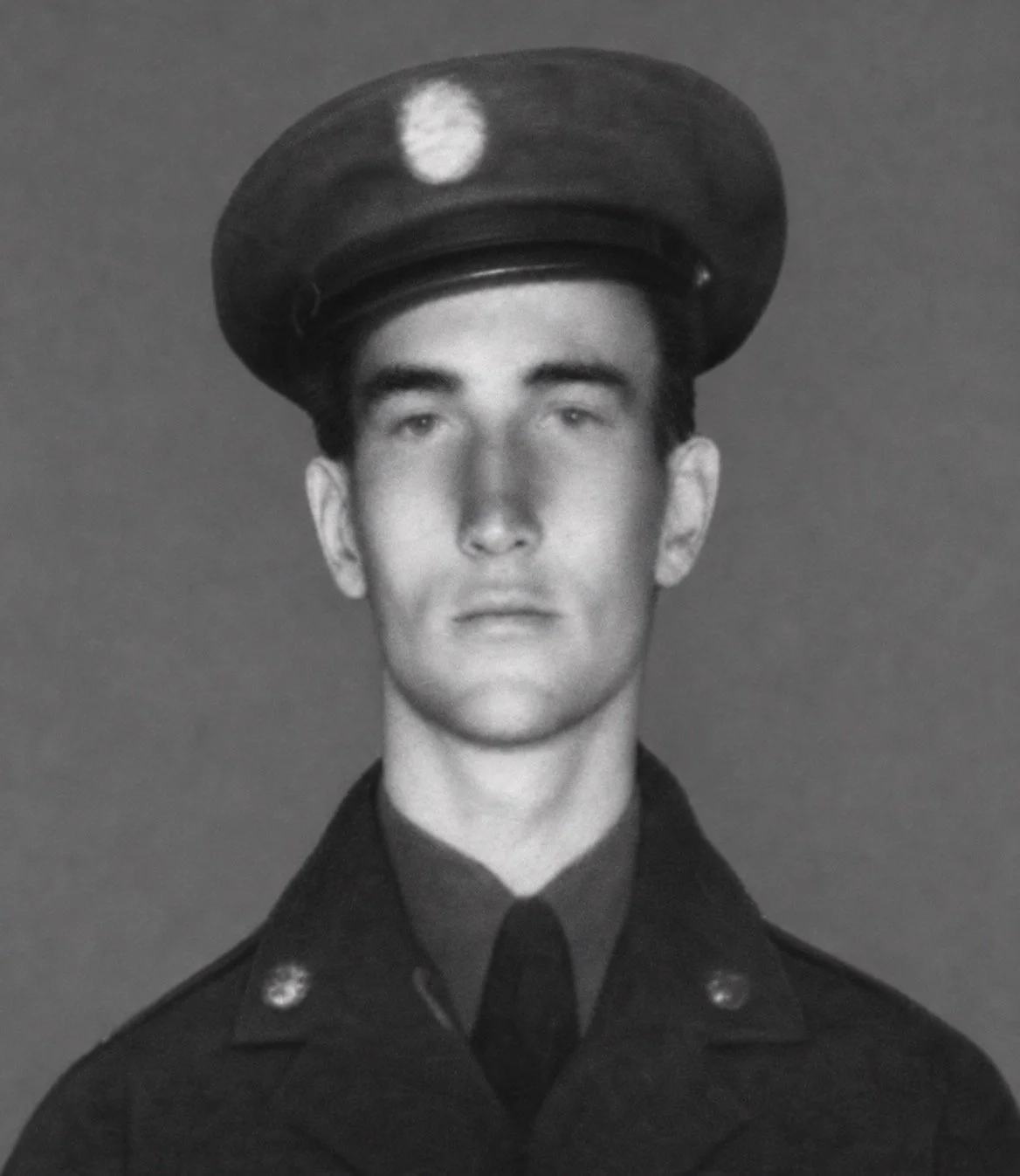
Original photograph, enhanced with AI assistance.
Lloyd J. George
Lloyd J. George of Myers, Nicholas County, Kentucky, was killed by enemy action in northwestern Africa on January 30, 1943. He was 23. A Kentucky National Guardsman who first enlisted in Carlisle, he went overseas with the 103rd Separate Coast Artillery Battalion. A wartime tribute identified him as the first soldier from Nicholas County known to have been killed in action in World War II.
George was born in Myers on March 16, 1919, to Samuel Henry George and Bessie J. Sapp George. He grew up with five sisters and two brothers. The 1920 and 1930 federal censuses, as summarized in the nomination packet, place the family in Myers. He completed eight years of school, worked as a farmer, and was unmarried.
George first enlisted in February 1935 in the Howitzer Company, 149th Infantry, at Carlisle. The nomination records several periods of service separated by honorable discharges. He reenlisted in July 1936, April 1937, and December 1938. In October 1939 the Carlisle unit became Troop A, 122nd Quartermaster Squadron. George reenlisted on June 11, 1940.
On November 1, 1940, the Carlisle unit became Headquarters Battery, 103rd Separate Coast Artillery Battalion. The battalion entered federal service on February 24, 1941, and trained at Fort Sheridan, Illinois. It sailed from New York on April 30, 1942, and arrived in Northern Ireland on May 15. Following orders to transfer to North Africa, it arrived there on December 8, 1942, and was assigned to the 34th Coast Artillery Brigade (Antiaircraft).
George’s battalion joined the campaign after the November 1942 Operation Torch landings. The Allies were fighting to gain control of Tunisia, and antiaircraft units supported the campaign by defending against enemy aircraft. On January 30, 1943, German forces attacked Faïd Pass in central Tunisia. That action marks the wider campaign on the day George died. His available records establish death by enemy action but do not identify the exact location, the engagement, or his duties when he was killed.
Army chaplain Capt. Alexander K. Davidson wrote to George’s mother in May 1943 that he had officiated at her son’s burial in the U.S. military cemetery at Tébessa, Algeria. The letter described George as a private first class. The Memorial nomination records a posthumous grade of technician fifth grade, addressed as corporal.
George was posthumously awarded the Purple Heart. Governor Keen Johnson named him a Kentucky Colonel on April 9, 1943. At a May 1943 ceremony at the Nicholas County courthouse, local officials paid tribute to his sacrifice. In 1947, Carlisle Veterans of Foreign Wars Post 8666 was named in his honor.
His remains returned to Kentucky in June 1948. On June 20 he was buried with full military honors. He is buried in the Carlisle Cemetery in Nicholas County. The Kentucky National Guard Memorial Fund approved his nomination on March 20, 2023, and his name was among five added for the 2023 Memorial Day ceremony.