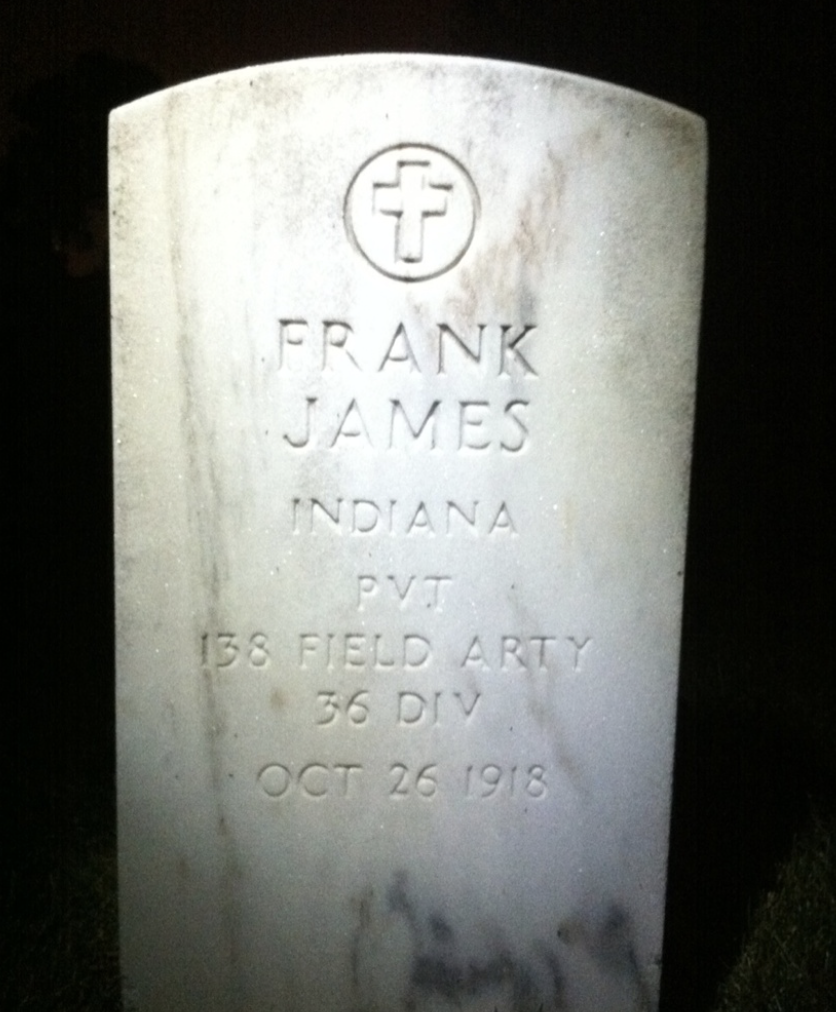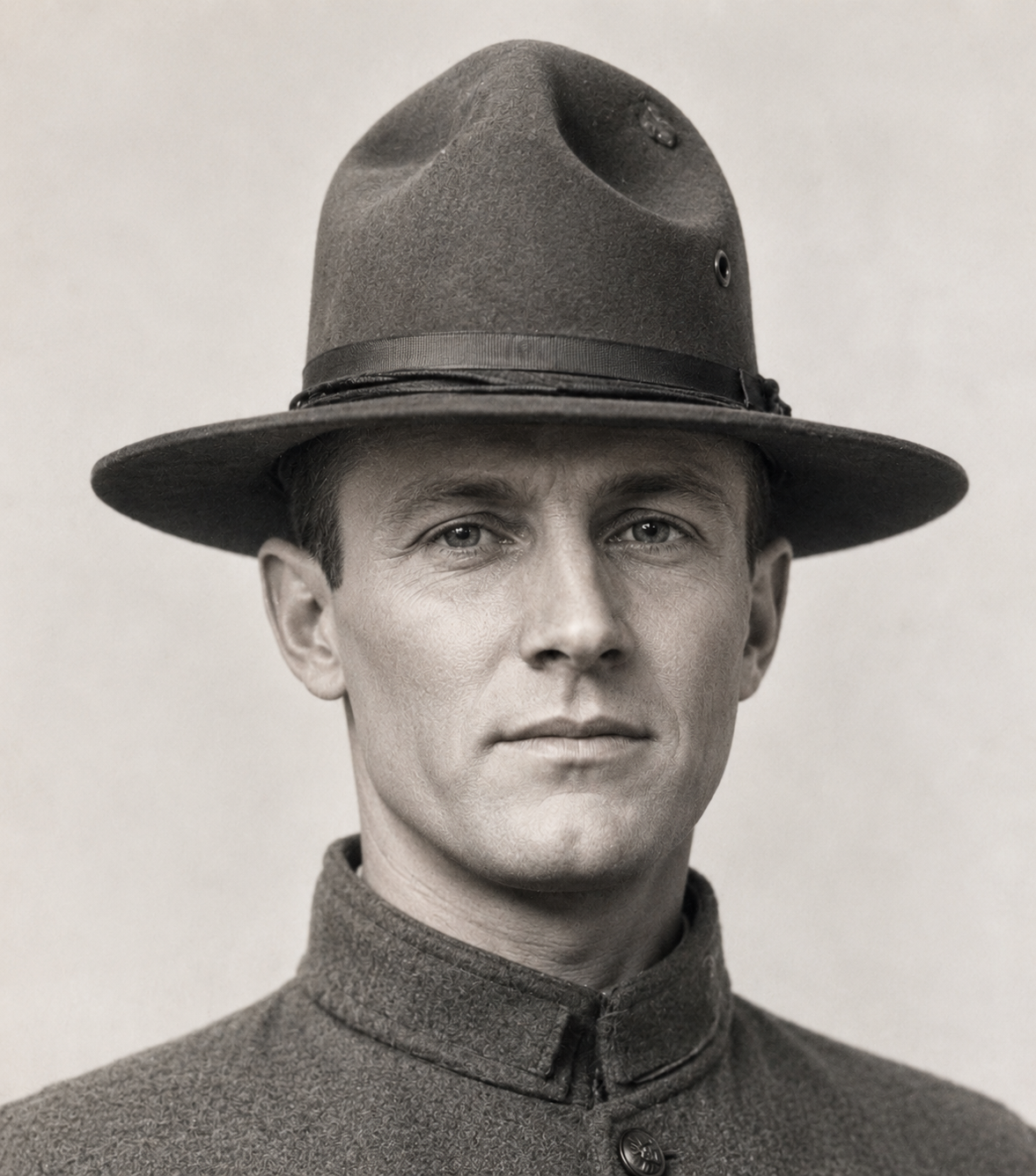
Frank “Dick” James
Private Frank James a.k.a. Frank Newton was born on 3 December 1882 in Roseville, Hancock County, Kentucky, to John James and Amanda (Wilkey) Hancock. Raised in western Kentucky, he grew to adulthood during a period of industrial expansion and opportunity in the American Midwest.
Although no official service records have been located, a newspaper account of his death indicates that Frank —only fifteen years old at the time—served during the Spanish-American War under the name Frank Newton. While below the legal enlistment age, such service was not unheard of in 1898, when enlistment standards were often loosely enforced amid a surge of patriotic volunteers. It is plausible that Frank either misstated his age or was accepted under the alias of Frank Newton based on appearance and determination, a practice documented among underage soldiers of the era. This early episode of service, though difficult to verify in official records, reflects a consistent pattern in his life—an unwavering desire to serve his country, regardless of age or obstacle.
By 1910, Frank had relocated to Vanderburgh County, Indiana, where he worked as a plumber, a skilled trade requiring discipline, precision, and reliability.
By the time the United States formally entered World War I on 6 April 1917, Frank Newton was 34 years old—an age that placed him at or beyond the upper limits for reenlistment under prevailing Army standards. Undeterred by these restrictions, and driven by a steadfast sense of duty, he once again found a way to serve. Assuming the name “Frank ‘Dick’ James,” he successfully enlisted on 17 April 1917 and joined the ranks of Kentucky’s 138th Field Artillery Regiment in Louisville, Kentucky continuing a lifelong pattern of determined patriotism.
Frank reported for training at Camp Zachary Taylor before being assigned to Battery B, 138th Field Artillery, a regiment of the 38th Division composed primarily of Kentucky National Guard units. He later transferred to Headquarters Company of the 138th Field Artillery while training continued at Camp Shelby, Mississippi.
In September 1918, elements of the division began movement overseas. The 113th Ammunition Train, which supported the division’s artillery units, departed Camp Shelby on 18 September 1918. Private James embarked from New York on 6 October 1918, arriving in Liverpool on 18 October and in Cherbourg, France, on 22 October 1918. Like thousands of American soldiers newly arrived in Europe, he began movement by rail toward staging and assembly areas in Brittany.
On the evening of 26 October 1918, near the rail station at Gaël, France, disaster struck. A train carrying elements of the 138th Field Artillery, including Headquarters Company, had stopped—reportedly due to mechanical difficulty. Headquarters Company occupied the rear six cars of the halted train. Following behind was another train carrying Kentucky’s 113th Ammunition Train. At approximately 8:50 p.m., the second train collided with the stationary cars, telescoping multiple wooden railcars and completely demolishing the rear section of the stopped train.
In darkness and confusion, fellow soldiers attempted rescue operations. Communication lines were downed in the wreckage, and a messenger was sent on foot to the nearest communication point several miles away. Medical assistance arrived from Camp Coëtquidan during the early morning hours. The wounded were evacuated, and the dead were gathered for burial and identification.
Private Frank James along with 11 other members of his unit was killed in this catastrophic railroad collision on 26 October 1918, just sixteen days before the Armistice that ended World War I. He was 35 years old at the time of his death.
Private Frank James along with 11 other members of his unit was killed in this catastrophic railroad collision on 26 October 1918, just sixteen days before the Armistice that ended World War I. Initially buried at U.S. Government Cemetery No. 18, Camp Coëtquidan, St. Malo-de-Beignon, Morbihan, France, he was reinterred on 9 February 1922 in Section 18, Grave 4218 in Arlington National Cemetery, Arlington, Virginia.
Though not lost in direct combat, Private James died in service to his country during wartime movement operations—reminding us that the hazards of war extend beyond the battlefield. His sacrifice represents the service of Kentucky’s citizen-soldiers who answered the call in 1917 and served faithfully overseas during the First World War.
Known Kentucky Soldiers Killed in the Great Train Wreck of 1918:
· PVT William E. Aubrey
· PVT Buford G. Craig
· PVT Frank “Dick” James, a.k.a Frank Newton
· PVT Norbert V. Henry
· PVT Charles Lucas
· PVT Watkins A. Moss
· PVT Walter C. Neagle
· PVT Roy V. Ogle
· PVT Ralph Rose
· PVT James N. Tucker
· PVT Garland W. Wells
· PVT Walter C. Yeager
[1]Gold Star Honor Roll of Indiana, World War I (1914–1918), p. 639.
[2]Evansville Courier and Press, 7 Dec 1918