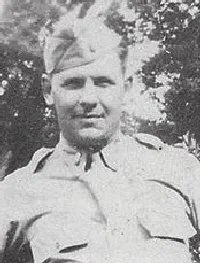
Bonnie L. Langnehs
First Lieutenant Bonnie Louis Langnehs, 23, of Louisville, Jefferson County, was killed in combat during the Normandy Invasion on 9 June 1944 near Amfreville, some five miles east of Sainte-Mère-Église, France, while leading the 1st rifle platoon of Company C, 325th Glider Infantry Regiment, 82nd Airborne Division. He is buried in the Normandy American Cemetery in Colleville-sur-Mer, France, in Plot B, Row 12, Grave 27.
Langnehs joined Battery F of the 138th Field Artillery of the Kentucky National Guard in October 1940 as a private in the signal section. In April 1941 he was promoted to Corporal. He was inducted into federal active duty with his unit in January 1941 and sent to Camp Shelby.
Langnehs married Geneva (maiden name not known at this time) sometime after October 1940. On 23 October 1941, after the birth of twin daughters Bonnie Lee and Joyce Ann, he was relieved from active duty, returned to state status and assigned to the state detachment of the active National Guard of Kentucky.
He returned to active duty in late January 1942 and was selected for officer candidate school. He was commissioned a second lieutenant at Fort Benning in December 1942 and was subsequently assigned to the 82nd Airborne Division. He deployed overseas in December 1943. His awards and decorations include a Purple Heart. In civilian life he had been the floor manager of the Fontaine Ferry roller rink.
The Battle of La Fière Bridgehead, 6-9 June 1944, is considered one of the costliest small-unit actions in the history of the U.S. Army, with some 254 killed and 525 wounded. One of the soldiers in Langnehs's unit, Private First Class Charles N. DeGlopper, was awarded the Medal of Honor for his actions at the Merderet River at La Fière on 9 June 1944, the same day Langnehs died. DeGlopper's platoon had advanced to secure a bridgehead but became cut off and surrounded by superior German forces. He volunteered to cover his comrades' withdrawal with his automatic rifle, walked into the road in full view of the enemy and kept firing, even after being wounded, until he was killed. His sacrifice allowed the platoon to escape and helped establish the first bridgehead over the Merderet. No details of Langnehs's own death have been discovered.