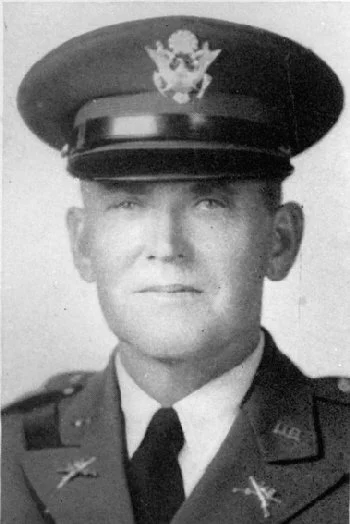
Joe Leech
Captain Joe Leech, 59, of Sedalia, Graves County, Kentucky, died on 1 October 1945 while on federal active duty during World War II, at the Kennedy General Hospital in Memphis, Tennessee, of carcinoma of the stomach.
Leech served on active duty from October 1917 to December 1918 as a Sergeant with the 159th Depot Brigade, Quartermaster Corps, at Camp Taylor, Louisville. He joined the Kentucky National Guard's Company L, 149th Infantry, at Mayfield in February 1922 as a Second Lieutenant when the company was formed. He was 36 and entered under an age waiver. Leech listed his civilian occupation as a farmer.
Leech was promoted to Captain and made commander of Company L in August 1928. A letter of resignation from Leech, citing business reasons, was found in his file, dated December 1933, but he was still serving as company commander in August 1934 when an efficiency board found that "Captain Leech has improved the efficiency of his company to a great degree during the past year in spite of serious handicap in the inadequacy and unfitness of armory at his home station and hostility of certain elements of the civilian population there." The hostility may refer to a robbery at the armory about a year earlier, in which weapons, clothing and equipment were stolen. Four arrests were made and some property recovered, but no record of the details or outcome has been found. In his report to the Adjutant General, he stated that he was dealing with some very bad characters considered dangerous by local civil authorities, and asked that a revolver be issued to him. There is no record showing whether one was issued.
When Company L was called to federal active duty on 17 January 1941, Leech was the commander, and he continued in that role when the company moved to Camp Shelby. He served as an umpire during the Louisiana Maneuvers of August and September 1941, a series of exercises across northern and west-central Louisiana designed to evaluate U.S. troop training, logistics, doctrine and commanders. The maneuvers involved half a million men in 19 Army divisions over 3,400 square miles. Leech apparently became ill during this time and was hospitalized in New Orleans for a time. When he returned to duty, he was sent to the Columbus, Mississippi, Army Air Base as administrative officer.
Leech had undergone an operation on his stomach a few weeks before his death and never fully recovered. He was home on leave when his condition worsened, and he was admitted to the hospital in Memphis, where he died. According to newspaper accounts, one of Captain Leech's last requests to his family was to be buried in his Army uniform.