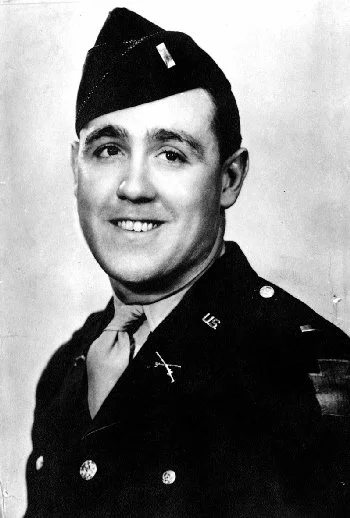
Kenneth G. Maddox
First Lieutenant Kenneth G. Maddox, 25, of Louisville, Jefferson County, died in a German field hospital on Christmas Day, 25 December 1944, of wounds received in battle. He was wounded on 17 December 1944, the second day of the Battle of the Bulge, near Clerf (Clervaux), Luxembourg, while serving on federal active duty with Headquarters Company, 2nd Battalion, 110th Infantry Regiment, 28th Infantry Division.
Maddox joined the 138th Field Artillery Band of the 38th Division in 1941. He was selected for officer candidate training while on federal active duty, graduated as a second lieutenant and was assigned to the 28th Division. In July 1944, seven weeks after the Allied invasion of France, he and the rest of the division landed in Normandy. They took part in Operation Cobra and fought through France to Paris, which was liberated on 25 August 1944. The 28th led the victory parade on 29 August, and Maddox rode in his jeep through Paris as crowds lined the streets. The division was the first Allied division to enter Germany, in September 1944, and moved to Luxembourg in November.
Maddox was awarded the Silver Star and Purple Heart posthumously. An administrative building was named for him at Fort Knox, Kentucky, in 1945. We have not been able to verify whether the building still stands or whether the designation moved to a building at Fort Benning when the Armor School relocated.
He was first buried in Germany, then moved to the American Military Cemetery in Luxembourg after the war. At his family's request, he was returned to the United States in 1948 and buried in the Maddox family section of Evergreen Cemetery in Louisville.
Silver Star Citation
The President of the United States of America takes pride in presenting the Silver Star (Posthumously) to First Lieutenant (Infantry) Kenneth G. Maddox (ASN: 0-1293433), United States Army, for gallantry and intrepidity in action against the enemy while serving with the 110th Infantry Regiment, 28th Infantry Division, in directing one of his antitank gun crews guarding a main road into Clerf, Luxembourg, when his position was attacked by enemy tanks and infantry on 17 December 1944. While the men of his gun crew were busy engaging an enemy tank, an enemy soldier approached with a machine gun. Seeing that the soldier was about to fire on his group at close range, Lieutenant Maddox courageously jumped in front of his men and received the entire burst, at the same time wounding his assailant with his weapon. His gallantry undoubtedly saved the lives of several men of his gun crew and reflects great credit upon him and the armed forces of the United States.
The Action at Clervaux
Historians John C. McManus (Alamo in the Ardennes) and Robert F. Phillips (To Save Bastogne) both describe the action. A lone 57mm antitank gun guarded the bridge into Clervaux as German armor descended the ridge. Maddox, directing the gun crew, saw a German soldier about to fire on them. The crew could not hear his warning over the noise of battle, so he stepped between them and the German and returned fire. Both men were mortally wounded, and moments later the Germans destroyed the gun position. Phillips notes that Maddox was severely wounded and evacuated by the Germans to a field hospital, where he died on Christmas Day.
Clyde Collins, the battalion surgeon, wrote to Maddox's father on 19 September 1945. He recalled that Maddox had lined up his small antitank guns along the road into town and, as German tanks broke through, defended the last gun with his carbine against six or seven Panzers. He was wounded, brought to the aid station, and patched up. Collins said he had a broken arm and leg and was in fair condition when the Americans were captured, but the Germans would not let them evacuate him to an American hospital.
A Family Mystery
In a letter to The Bulge Bugle (November 2017), Maddox's niece explained that the family did not learn until early 1945 that he had died. They had believed he was a prisoner of war and searched newsreels for his face. Three of his gun crew, Robert Weisenseel, Charles Shumaker and Joseph Russinbro, visited her grandparents after the war. She believes he died in the Clervaux Sanitarium, which was used as a field hospital first by the Americans and then by the Germans. Among his papers was a Western Union telegram dated 20 December 1944, wishing the family a happy Christmas and signed "Keep Smiling. Kenneth Maddox." By then he was likely gravely wounded in a German hospital, and he never signed letters that way, always using Ken or Kenny. Who sent the telegram, and who reported his death on Christmas Day? The Army's first daily report after 17 December listed him only as Missing in Action, so the information came from another source.
See Also
A World War II Odyssey: Lt. Kenneth G. Maddox's Journey from Louisville to Luxembourg: https://artsandculture.google.com/exhibit/zQLCJNz8pOLjIw
The Kentucky Historical Society holds an extensive collection of Maddox family items, including the Kenneth G. Maddox Papers (MSS 38) and the M. Hunt Maddox Collection: https://history.ky.gov