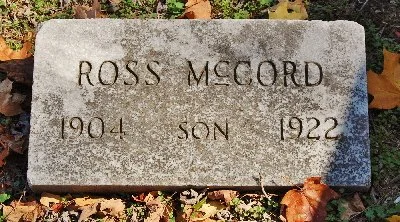
Ross L. McCord
Private Ross L. McCord, 18, of Hopkinsville, Christian County, was accidentally shot on 25 October 1922 while on state active duty at Ilsley in Hopkins County, about 10 miles southwest of Madisonville, with members of his unit, Troop C, 54th Machine Gun Squadron, during a coal strike. McCord died of his wounds at the U.S. Veterans Hospital at Dawson Springs on 28 October 1922. He is buried in Section G of Riverside Cemetery in Hopkinsville.
McCord was shot by fellow soldier Private John Weaver, 15, of Hopkinsville. According to newspaper accounts, the bullet shattered vertebrae in McCord's neck. The incident occurred in front of a pump house at the Magic Collieries Company plant near St. Charles, Hopkins County. In his defense, Weaver said he had his pistol in his hand to protect himself while walking his beat because he thought he was going to be attacked by an unknown assailant. McCord came around an automobile and Weaver did not recognize him in the darkness. Weaver said McCord seized his wrist and the pistol was accidentally discharged during the struggle.
McCord enlisted in the 125th Wagon Company of the Kentucky National Guard in Hopkinsville on 5 August 1922, listing his civilian occupation as laborer. His unit became Troop C, 54th Machine Gun Squadron, on 1 October 1922. McCord almost certainly attended annual training at Camp Knox with his unit on 13-27 August 1922. Immediately afterward, the unit was placed on state active duty and ordered to the Madisonville area for strike duty at the Sunlight Strip Mine. Union miners were on strike, and a national railroad strike was under way. Various units had been on duty in the area since early June, and sniper fire had been directed at the mine several times, most recently just days before McCord arrived. On 9 August, Guardsmen with machine guns scattered a group trying to sabotage a steam shovel at the site after the group ignored orders to halt and warning shots. No casualties were reported on either side.
Emotions were running high across the nation, and some feared that outside agitators would come to the Madisonville area and that the Herrin massacre would be repeated in Kentucky. Herrin, Illinois, where striking union miners and strikebreakers clashed on 21-22 June 1922 with more than 20 deaths, was only about 100 miles away.
Weaver was charged with manslaughter by a local grand jury and was acquitted after a trial on 12 May 1923. The Messenger-Inquirer of Owensboro reported on 13 May 1923 that the jury deliberated only 30 minutes. Weaver continued to serve in the Kentucky National Guard until he moved out of state and was honorably discharged on 3 July 1923.