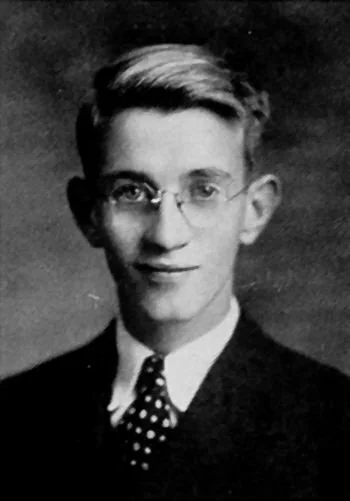
Kenneth Walsh
Private First Class Kenneth "Kenny" Walsh, 22, of Fort Thomas, Campbell County, Kentucky, was killed on 1 October 1941 when a fuel stove in a mobile field kitchen exploded near Arkadelphia, Arkansas. Walsh, a member of Battery C, 103rd Coast Artillery, was riding in the back of a truck carrying a mobile field kitchen in a convoy returning with his unit from the Louisiana war games to their home station at Fort Sheridan, Illinois.
Private First Class Marlon Combs, 22, of Carrollton, Carroll County, formerly of Covington, was also critically injured. Both men were taken to the Army and Navy General Hospital in Hot Springs, Arkansas, where Walsh died of his injuries.
According to newspaper accounts, the men were refueling the stove in the mobile army kitchen on U.S. Highway 67 while the convoy was moving. The fuel fumes are believed to have ignited, and the men were unable to get out of the cage in the back of the truck. The driver continued for some distance before he realized what had happened. Other members of the convoy and Arkansas State Patrolman R. E. Brown, who witnessed the event, removed the men from the truck and rolled them in blankets. Brown rushed them in his patrol car to the nearest hospital, Townsend Hospital in Arkadelphia, about two miles from the scene. Combs was able to walk into the hospital under his own power. Walsh, who was much more severely burned, was conscious but had to be treated before he could be moved from the patrol car. After first aid, both men were moved by Army ambulance to Hot Springs.
Before going on active duty, Walsh worked at the Cloverleaf Dairy Company in Newport. He was a graduate of Highlands High School in Fort Thomas. One of his five brothers, Ones C. Walsh Jr., was also a member of Battery C, 103rd Coast Artillery, at the time of the accident. On 4 April 1942, officers and men of Battery C presented a bronze plaque in memory of their "buddy" to his mother, Mrs. Lutie Walsh, of Wilbers Lane in Fort Thomas; Ones Walsh Jr. made the presentation on behalf of the battery. The plaque bears a picture of Walsh and calls him a good soldier, loyal and attentive to his duty, loved and admired by his fellow soldiers and officers. Another brother, Private Robert Walsh, was stationed at Camp Shelby, Mississippi, and a third, William Walsh, was on the staff of the Newport office of The Cincinnati Enquirer.
In October 1940 the 123rd Cavalry Regiment was disbanded and redesignated as two Coast Artillery battalions, the 103rd Separate Battalion (Anti-Aircraft) and the 106th. The 103rd trained at Fort Sheridan beginning in March 1942, left New York on 30 April, and arrived in Northern Ireland on 15 May. It moved to North Africa in December, took part in the Sicily Campaign (Operation HUSKY) from 9 July to 17 August 1943, and served in Scotland, Belgium, Germany and Czechoslovakia before returning to New York on 30 November 1945. It was inactivated on 1 December 1945 at Camp Kilmer, New Jersey, and redesignated in 1946 as the 441st Field Artillery Battalion. Its lineage and honors are now carried by the 2nd Battalion, 138th Field Artillery, headquartered in Lexington.
Other casualties of the 103rd Antiaircraft Artillery Battalion in World War II were Maj. Mortimer M. Benton, Cpl. Opal E. Cornn, Pvt. Buster Criswell, 1st Lt. Hal T. Hackney, 1st Lt. Thomas L. Hehman, T/5 Richard A. Heidkamp, 1st Lt. Jeff Johnson Jr. and T/5 Owen W. Whitaker.
See also: The Kentucky Post, 2 October 1941, p. 1; The Cincinnati Enquirer, 2 October 1941, p. 1; "Plaque Presented in Memory of Northern Kentucky Soldier," The Cincinnati Enquirer, 5 April 1942, p. 31.